Keratoconus treatment

Five Things I Tell My Keratoconus Patients

Written by Dr. Bruce Nguyen OD

Treating keratoconus based on research, not intuition

*Note: The story below is shared with our patient’s permission to raise awareness about the condition of keratoconus and the fact that keratoconus is significantly being misdiagnosed or underdiagnosed routinely.
A new patient to our office walked into the exam room and proudly declared that her eyes are “just plain weird,” so we should just go ahead and ignore any readings coming from our instruments when measuring her eyes or just skip the tests entirely.
As a rule, we usually do not get too many patients coming in for eye exams asking the doctor to skip tests or ignore the test results, so naturally, I was curious. When asked what she meant exactly, she replied that ever since she was a teenager, her glasses prescription numbers as measured by the machines and as measured by the doctors never matched. They simply never agree, and she was never able to see the 20/20 line on the eye chart. “No one knows why I cannot see well”, she said.
When she came to us, she was already in her late twenties, and she had accepted long ago that her eyes were just “weird.” She just wanted a new pair of glasses, so she decided to come to our office for a routine annual eye exam since she has not had one for a long time.

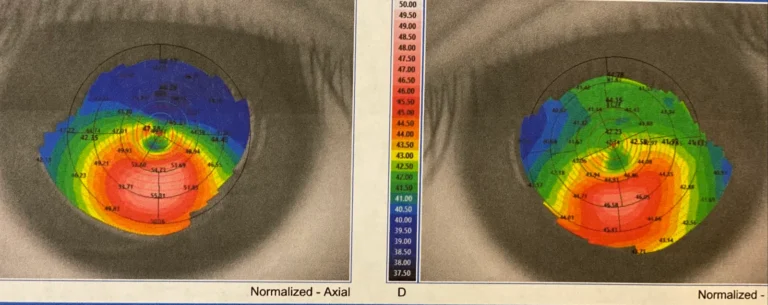
Suspecting a case of undiagnosed keratoconus, I performed a corneal topography scan on her eyes. The scan confirmed a case of moderate bilateral keratoconus. Showing the patient, the 3-D scans of her cone-shaped cornea (the clear part of the eyes), I said gently, “I’m afraid that you have keratoconus in both eyes, that may be the main reason is why you have been having all these vision issues”.

And you know what her reactions were? She was actually laughing and in general being happy to hear the news.

Facing such inappropriate and unexpected reactions, I was taken aback, but then I understood and sympathized with her. The relief of finally knowing what was wrong with her eyes after all these years momentarily overcame the natural apprehension and worries of receiving such unwelcome news.

OUR TESTIMONIALS

1. Keratoconus is commonly under-diagnosed

Keratoconus is an eye disease affecting the transparent structure in front of your iris called the cornea. Usually described as a dome-shaped structure, the cornea focuses light onto your retina, helping you see clearly.
Have you ever heard this phrase from your eye doctor: “You have astigmatism”? What is astigmatism? Astigmatism is a condition where your eye is shaped like a football, (or an egg).” That is the shape of the cornea she was talking about, not the shape of the entire eyeball.
With keratoconus, the cornea experiences gradual and progressive thinning over time, causing destabilization of best-corrected vision, unwanted irregular astigmatism, and excessive, disabling halos and glares, especially much worse at nighttime.
Depending on which studies you get your hands on, the chance of having keratoconus is anywhere from 1 in 500 to 1 in 2000 [1]. More recently, The Journal of Cornea and External Disease published a study in its February 2020 issues, estimating a rate of approximately 1.38 in 1000 for keratoconus [2].
Affecting all genders and races, keratoconus usually started during puberty or early adulthood, around 15 years of age [4]. Sadly, proper diagnosis is not always made at that time, sometimes delayed by several years like in the case of our patient.
Advanced technology along with experience play a key role in the proper diagnosis and treatment of keratoconus. The best doctor to diagnose keratoconus is your eye doctor since it is usually diagnosed during an annual exam visit. Unfortunately, keratoconus is still significantly being underdiagnosed in the general population. In our office, we screen all of our patients for keratoconus during the annual wellness exam.

2. Keratoconus Runs in The Family

“It was found that children of consanguineous parents had a fourfold risk of keratoconus compared with children of unrelated parents […] and this association was much stronger with parents married to first cousins than second cousins.” [6]
Another reason for not marrying your cousin.
The exact cause of keratoconus is still unknown, even though the currently dominant theory on the subject leans over to the side of multiple gene involvement in the development of keratoconus rather than just a single major gene. Studies have shown that there are definitive links between eye rubbings, allergies, eczema, and systemic conditions such as Down syndrome, Ehlers-Danlos syndrome [5].
There is a definitive genetic component in the development and progression of keratoconus. If one of your relatives has keratoconus, you are at higher risk of developing keratoconus yourself. Vice versa, if you have keratoconus, then your relative, i.e., siblings or children, are also at risk. Even though the commonly quoted number is 1 in 10 on popular health informative website such as WebMD, the actual rate varies from study to study, ranging from 5% to 27% [6].
In a study by Gordon-Shaag A, et al. The genetic and environmental factors for keratoconus. Biomed. Res. Int. 2015, the researchers found that you would have a 14% chance of having keratoconus if one of your relatives was diagnosed with keratoconus.
In the same study, the rate goes up to 20% if that relative is your immediate family, i.e., one of your parents, siblings, or children [6]. In other words, if you have keratoconus, there is a 1-in-5 chance one of your loved one may have it as well.
This is a particularly important point that I always try to stress during my eye exam. I always urge my keratoconus patients to ask their relatives about their most recent eye exams. At the very least, I asked my patients to bring in their siblings or their children, if any, for an eye exam to specifically rule out keratoconus, even if the relatives can see perfectly fine. A one in five chance for your loved one to also have keratoconus is too high of a chance to take it lightly.
Early proper diagnosis of keratoconus, especially in children, is of vital importance. This is because the effectiveness of a new FDA-approved keratoconus treatment known as corneal cross-linking depends on the age of diagnosis and stage of the disease. You can read more about the best treatment for keratoconus below.

3. Keratoconus Almost Always Affects Both Eyes

Often, I would see keratoconus patients referred to our office by other doctors for scleral contact lenses as a treatment for keratoconus. By the time they see me, the patient would already have a good idea of what keratoconus is, and what kind of treatments are available thanks to our favorite doctor, Doctor. Google.
Yet, most are not aware that keratoconus almost always affects both eyes eventually, with unequal degrees of progression. This is especially true and a new source of distress for those patients who came in with a 20/20 eye on one side and a “bad” eye on the other. Since they only notice the blur, the glare, the aberration with just one eye, it is only natural for those patients to assume that only that one eye is affected and the other one is okay. The fact is that most keratoconus eventually progresses in both eyes.
Using computerized corneal imaging, the researchers in one study scanned both eyes of one hundred sixty-four keratoconus patients from the University of Texas Southwestern Medical Center and Wills Eye Hospital. Out of those 164 keratoconus patients, three (1.83%) were found with keratoconus affecting only one eye [7]. One out of three patients eventually developed keratoconus in the previously unaffected eyes.
In other words, if you were one of those patients in the research, there is about a 98% chance that your keratoconus condition could affect both eyes and not just one.
You can read the condensed version of the study here Holland DR, Maeda N, Hannush SB, et al. Unilateral keratoconus. Incidence and quantitative topographic analysis.
Other studies confirmed the hypothesis that unilateral keratoconus is rare. One study quoted only a 4% chance of having keratoconus in only one of the eyes.[8] Other research showed that even if you are truly unilateral, there is about a 50% chance it will develop in the other eyes in the next 16 years[9]. It sounds bad, but there is hope. Keep on reading.

4. Keratoconus Is Assumed to Be Progressive Until Proven Otherwise.

This is an important point. Most diseases of the body progress with time, there is no surprise in that. However, keratoconus is an interesting condition in this aspect, because it has been observed that keratoconus is seen much less commonly in patients older than 50 years versus the younger generation.
One of the most difficult tasks that I have to face in my office is having to be the one to tell parents that their beloved child has keratoconus. Most of the time, the kid stays silent and confused but parents are typically very upset. Such tasks never get easier overtime.
Commonly, the mean age of keratoconus diagnosis is from15 years of age [4] to 18 years of age [10], and the disease tends to progress for the next 20 years or so based on measurements of corneal curvatures changes. In other words, your keratoconus conditions would show stabilization 20 years after onset, somewhere around your late thirties to early forties.
One explanation for this phenomenon is that the corneas of keratoconus patients stiffen with age due to changes in corneal collagen fibrils [10].
The clear part of your eye known as the cornea stiffens with age and stabilizes the condition of keratoconus naturally.

Another way eye doctors treat keratoconus is using a procedure called corneal cross-linking to achieve the same type of cornea stiffening.

Corneal cross-linking is the best treatment available for keratoconus stabilization and scleral contact lens wear is the best treatment for keratoconus vision rehabilitation. Together, they form a powerful one-two punch combo against keratoconus.

5. There is an effective FDA-approved treatment

“I can see light at the end of the tunnel, and it isn’t a train.” – David Bowie.

If you make it here, you are probably depressed by now. Fortunately, there is a light at the end of the tunnel, and it is a UV light. In 2016, the FDA finally approved a surgical procedure called corneal cross-linking as a treatment for keratoconus, to the delight of keratoconus-enthusiast eye doctors everywhere. Corneal cross-linking (CXL) has been available in Europe for years prior to FDA approval in the US.

The procedure takes less than an hour, involving soaking your eyes with specialized vitamin B-12 eye drops, and then shining UV lights on them to create more cross-collagen bonds, thus making your eyes stronger which in turn slow down keratoconus progression.

The procedure has a success rate of more than 90%. [11] Put it simply, it is the best way we have today as of 2021 to significantly slow or even stop keratoconus from getting worse. Here is a short video of a patient undergoing a corneal cross-linking (CXL) procedure.

Corneal cross-linking is especially important in those patients that have 20/20 in one eye and “bad vision” in the other eye as mentioned above. Think about it. If you already have one bad eye, and the remaining eye is good, for now, your priority should be keeping the good eye from getting worse like the “bad” one.

Another important consideration is your age when corneal cross-linking is considered as a treatment option. Research showed that keratoconus is often more severe at the time of diagnosis when compared to adults, and in the case of progression, they also progress faster than adults [12]. Thus, it is most critical that once a proper diagnosis is made in children, corneal cross-linking or CXL should be the first treatment method for consideration.

At the time of this writing, December 2021, the FDA has approved only one cross-linking platform for the treatment of progressive keratoconus in patients older than 14 years of age: the iLink corneal remodeling platform (Glaukos). The platform consists of Photrexa Viscous (riboflavin 5’-phosphate in 20% dextran ophthalmic solution), Photrexa (riboflavin 5’-phosphate ophthalmic solution), and the KXL system, approved in 2016[11].

Insurance coverage varies depending on your plan coverage. It’s important to find out exactly what your insurance pl. covers before proceeding with corneal cross-linking. Paying attention to the enrollment window of your health insurance plan may allow you to change to a better coverage plan that could potentially save money on the procedure.

In San Diego where I practice keratoconus and myopia management, the typical price for corneal cross-linking for uninsured patients is around $6000 per eye, as of December 2021.

Conclusion

Keratoconus is a bilateral and progressive eye condition, usually starts during high school years and stabilizes around the early forties. There are multiple treatments available, but the best treatment for keratoconus usually involves corneal cross-linking (CXL) for vision stabilization and scleral contact lens wear for vision rehabilitation. Early diagnosis and intervention are the keys to successful management of the disease.

Dr. Bruce Nguyen specializes in keratoconus and myopia management in San Diego, California.

REFERENCES

Specialty Contact Lenses Specialist

Are you tired of struggling with discomfort and blurred vision caused by ocular surface disease, dry eyes, or keratoconus? Imagine a life where your eyes feel refreshed, and your vision is crystal clear. At our clinic, we have a dedicated team of expert scleral contact lens specialists ready to help you regain control of your eye health and quality of life.

FREQUENTLY ASKED QUESTIONS ABOUT SCLERAL LENSES

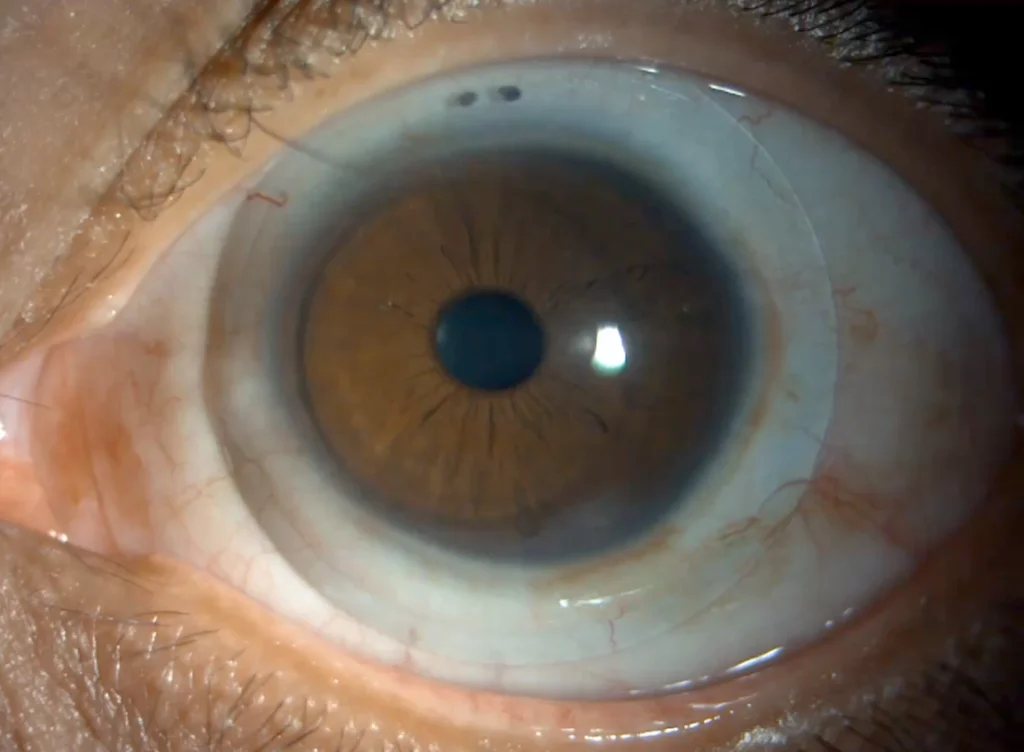
Scleral lenses are large, gas-permeable contact lenses that vault over the cornea and rest on the sclera, the white outer layer of the eye.
Unlike traditional contact lenses that sit directly on the cornea, scleral lenses have a larger diameter and rest on the sclera, providing greater stability and comfort, especially for irregular corneas or dry eyes.
Scleral lenses are beneficial for various eye conditions, including keratoconus, irregular astigmatism, post-surgical corneas, ocular surface disease, and severe dry eye syndrome.
Scleral lenses are often more comfortable than traditional lenses due to their larger size and ability to maintain a constant layer of fluid between the lens and the cornea, providing relief for dry eyes.
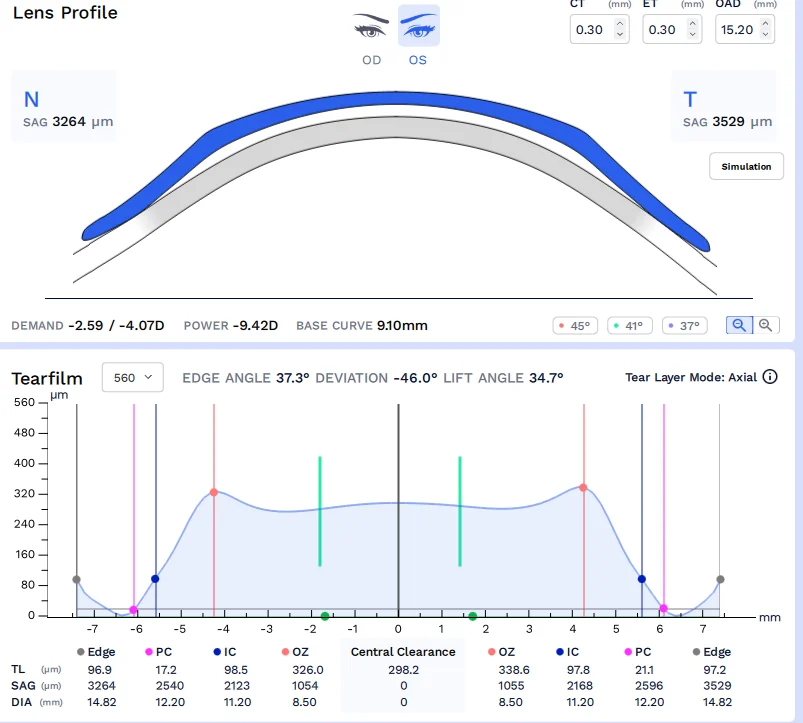
Scleral lenses are custom-fit to each individual’s eye shape and prescription. A specialized fitting process, conducted by an eye care professional, ensures optimal comfort and vision correction.
Maintenance typically involves cleaning the lenses with a specialized solution, filling them with preservative-free saline solution before insertion, and disinfecting them after each use.
The wearing time for scleral lenses varies depending on individual factors such as eye health and comfort. Some people can wear them all day, while others may need to remove them periodically for cleaning and rest.
Coverage for scleral lenses varies depending on your insurance plan and the specific medical indication for which they are prescribed. It’s best to check with your insurance provider to understand your coverage options.

If you experience discomfort or irritation, remove the lenses and rinse your eyes with preservative-free saline solution. Contact your eye care professional for further guidance and evaluation. Adjustments to the fit or prescription may be necessary for optimal comfort.


If you have keratoconus, or ocular surface diseases, book your consultation with our expert doctors and let us help you improved your sight and comfort today.

Click on the button to schedule consultation today!

MAJOR Insurance Providers Accepted

Below is a short list of just some of the plans we accept. Please contact our office if you do not see your insurance provider listed on our site.